Services and tools

Packaging Regulation (PPWR)

What is the new Packaging Regulation 2025/40?

The Packaging and Packaging Waste Regulation 2025/40 (PPWR) is a European regulation forming part of the EU’s broader circular economy policy framework. Its main goal is to minimise the amount of packaging and packaging waste produced, reduce the use of virgin raw materials and support the transition towards a sustainable, circular and competitive economy.

The PPWR introduces a new set of obligations covering the entire life cycle of packaging, from design to waste management. The measures aim to significantly reduce greenhouse gas emissions and water consumption by 2030, while also limiting the negative impacts of packaging on the environment and human health.

Entry into force and objectives

On 22 January 2025, the Official Journal of the European Union published the new Regulation (EU) 40/2025 on packaging and packaging waste (Packaging and Packaging Waste Regulation – PPWR).

The Regulation on packaging and packaging waste entered into force on 11 February 2025, but its provisions will apply from 12 August 2026. 

Result of a complex legislative process at European level, the Regulation introduces a substantially renewed regulatory framework designed to improve the sustainability, efficiency and management of the packaging and packaging waste sector across all areas of use.

Its key objectives include:

  • preventing the generation of packaging waste and reducing its quantity;
  • avoiding and limiting packaging waste, including by promoting re-use and refill systems;
  • ensuring that by 2030, all packaging placed on the EU market can be recycled in an economically sustainable way;
  • increasing the safe use of recycled plastic in packaging, thereby promoting the market for secondary raw materials.

  • Restrictions on certain single‑use plastic packaging, such as packaging for fruit and vegetables under 1.5 kg, or individual condiment portions in food service settings;
  • An obligation to minimise packaging weight and volume, reducing empty space as far as possible;
  • Binding targets for 2030 and 2040 on minimum recycled content levels in plastic packaging;
  • The possibility for customers to use their own containers for takeaway food without additional costs;
  • Restrictions on substances of concern, such as PFAS, with specific limits for their presence in packaging.

What changes for packaging design under Regulation (EU) 2025/40?

Here are the main new features for packaging design introduced by Regulation 2025/40, relating to sustainability and labelling requirements:

  • Requirements for substances in packaging (Article 5);
  • Recyclable packaging (Article 6);
  • Minimum recycled content in plastic packaging (Article 7);
  • Biobased feedstock in plastic packaging (Article 8);
  • Compostable packaging (Article 9);
  • Packaging minimisation (Article 10);
  • Reusable packaging (Article 11);
  • Labelling of packaging (Article 12).

Handbook on the prevention measures

Overall timeline for compliance with sustainability requirements – Regulation 2025/40

Check here the deadlines for businesses and the European Commission’s timelines according to Regulation 2025/40

FAQ PPWR

Compostable packaging

For non-permeable single-serve units, compostability is at the discretion of each Member State when specific conditions apply at national level. Depending on the type of capsule, there are diffe-rent provisions in Regulation 2025/40:

› According to Article 3, paragraph 1, point (f), the definition of packaging includes “a permeable tea, coffee or other beverage bag, or soft after-use system single-serve unit that contains tea, coffee or another beverage, and which is intended to be used and disposed of together with the product”.

With regard to those items, Article 9 of Regulation 2025/40 stipulates that, by 12 February 2028, such packaging must be compostable under industrial composting conditions. Member States may also require compatibility with home composting, if provided for in national legislation.

› With regard to non-permeable single-serve units (Article 3, paragraph 1, point (g), compostability is not mandatory at EU level, but may be required by Member States, provided that adequate collection and treatment systems for bio-waste wa-ste exist.

For permeable tea bags, coffee bags or bags for other beverages, or single-serve, single-use units that are soft after use, which contain tea, coffee or another beverage, and are intended to be used and disposed of together with the product, there is a general com-postability requirement from 2028.

The filters in question fall within the category of packaging.

In particular, a permeable tea, coffee or other beverage bag, or soft after-use system single-serve unit that contains tea, coffee or another beverage, and which is intended to be used and disposed of together with the product, will be considered packaging from 12 August 2026 and will therefore be subject to environmental label-ling requirements.

They must bear the identification code pursuant to Decision 129/97/ EC referring to the material composition of the wrapping.

With regard to disposal instructions, compostable capsules, bags and sachets in accordance with UNI 13432 these will be destined for separate collection for bio-waste and must bear all the man-datory information required for items with these characteristics (for further details, please refer to page 32 of the Guidelines on the labelling of packaging pursuant to Article 219, paragraph 5 of Legi-slative Decree 152/2006 as amended). The use of digital channels is always possible to convey this information in accordance with the procedures already set out in the official guidelines.

It should also be noted that the above-mentioned environmental labelling requirements for packaging will be subject to change, as Regulation 2025/40 stipulates that from 12 August 2028, packa-ging must bear a harmonised label for all Member States in accordance with the implementing acts to be adopted by the European Commission by 12 August 2026.

Compostability with regard to compatibility with the standards for composting in industrially controlled conditions in bio-waste tre-atment facilities will be mandatory, pursuant to Article 9 of Regu-lation 2025/40.

The introduction of the requirement for compatibility with home com-posting standards is, however, at the discretion of each Member State. With regard to non-permeable coffee capsules (defined by Article 3, point (g) of Regulation 2025/40), it will be up to each Member Sta-te to impose compostability requirements; it should be noted that, in accordance with the single market as highlighted in Article 4 of Regulation 2025/40, this flexibility is subject to compliance with the TRIS notification procedure. See Article 9, paragraph 2, point (a): “By way of derogation from Article 6, paragraph 1, where Mem-ber States allow waste with similar biodegradability and composta-bility properties as bio-waste pursuant to Article 22, paragraph 1 of Directive 2008/98/EC to be collected together with bio-waste, and appropriate waste collection schemes and waste treatment infra-structure are available to ensure that compostable packaging enters the bio-waste management stream, Member States may require that the following packaging shall be made available on their territory for the first time only if the packaging is compostable:

a) packaging referred to in Article 3, paragraph 1, point (1)(g), composed of material other than metal, very lightweight plastic carrier bags and lightweight plastic carrier bags (...)”.

Compostable packaging is defined as “packaging that biodegrades in industrially controlled conditions or that is capable of un-dergoing biological decomposition in such conditions, including through anaerobic digestion, but not necessarily in a home-composting environment, combined, if necessary, with physical treat-ment, resulting ultimately in the conversion of the packaging into carbon dioxide or, in the absence of oxygen, methane, and mineral salts, biomass and water, and that does not hinder or jeopardise the separate collection and the composting and anaerobic dige-stion process”.

To date, the reference standard for compostable packaging is EN 13432.

Then, by 12 February 2026, it will be up to European standardisa-tion organisations to prepare harmonised standards with technical specifications for industrial and home composting.

Yes, the reference is made by Article 3, paragraph 1 of Regulation 2025/40, which includes in the definition of packaging in point (f) the “permeable tea, coffee or other beverage bag, or soft after-use system single-serve unit that contains tea, coffee or another be-verage, and which is intended to be used and disposed of together with the product”.

By 12 February 2028, packaging other than that referred to in paragraphs 1 and 2 of Article 9 of Regulation 2025/40, including packaging made from biodegradable plastic polymers and other biodegradable materials, must be designed for the recycling of the reference materials, as must all other packaging placed on the market, in accordance with Article 6 of Regulation 2025/40 and without compromising the recyclability of other waste streams. Recital 53 reads: “As the proper disposal route for compostable plastic packaging is becoming increasingly confusing for consumers, it is justified and necessary to lay down clear and common rules on the use of compostable plastic packaging, mandating it only when its use brings a clear benefit for the environment or for human heal-th.” Therefore, only the packaging indicated in paragraphs 1 and 2 may be compostable. The Commission may consider the possibility of including other packaging in paragraph 1 or paragraph 2, point (a).

Article 9, paragraph 1 of Regulation 2025/40 stipulates that each Member State may require that non-permeable single-serve units intended for use in a system for preparing tea, coffee or other be-verages (intended for use in a machine and used and disposed of together with the product) also be compostable (if made of mate-rial other than metal). Where the Member State imposes this obligation, non-permeable single-serve capsules may also only be pla-ced on the market if they are compostable. However, in accordance with the single market, this flexibility is subject to compliance with the TRIS notification procedure.

Each Member State may decide, by August 2026, to introduce a compostability requirement for plastic capsules placed on its territory, provided that there is an infrastructure for the collection and recycling of the organic fraction.

FAQ PPWR

Deposits

The “deposit and return system” is defined as “a system in which a deposit is charged to the end user when purchasing a packaged or filled product covered by that system, and redeemed when the deposit bearing packaging is returned through one of the collection channels that are authorised for that purpose by the national authorities”. Regulation 2025/40 requires Member States to establish deposit and return systems by 1 January 2029, with particular reference to achieving the target of at least 90% separate collection for:

  1. single-use plastic beverage bottles with a capacity of up to three litres; and
  2. single-use metal beverage containers with a capacity of up to 3 litres.

On a voluntary basis, Member States are encouraged to establish and maintain deposit and return systems for other types of packaging, in particular for single-use glass beverage bottles and beverage cartons.

Annex X to the Regulation 2025/40 sets out the minimum requirements for deposit systems and for the labelling of packaging that is part of a deposit system. This labelling will be defined in an implementing act.

In order to avoid the obligation to establish a deposit system for packaging under points (a) and (b), Member States must achieve a separate collection rate of at least 80% by 2028 and submit a request for a derogation, accompanied by a plan to achieve the 90% target by 2030. If the derogation is granted, it will lapse if the separate collection rate falls below 90% for three consecutive years.

At present, it is not possible to know what national measures will be taken to comply with these requirements.

FAQ PPWR

EU Declaration of conformity

The EU declaration of conformity certifies that compliance with the sustainability and labelling requirements established by Regulation 2025/40 has been demonstrated. In particular, it is a document that demonstrates compliance with the requirements relating to:
› Requirements for substances in packaging (Article 5);
› Recyclable packaging (Article 6);
› Minimum recycled content in plastic packaging (Article 7);
› Biobased feedstock in plastic packaging (Article 8);
› Compostable packaging (Article 9);
› Packaging minimisation (Article 10);
› Reusable packaging (Article 11);
› Labelling of packaging (Article 12);

It must be drawn up by the manufacturer and must be requested and checked by importers.

Based on the provisions of Article 15 of Regulation 2025/40, it is the responsibility of packaging manufacturers, before placing packaging on the market, to carry out (or have carried out on their behalf) the procedure for assessing the conformity of the packaging with the requirements of Regulation 2025/40 (provided for in Article 38) and draw up the technical documentation referred to in Annex VII. Where compliance of packaging with the applicable requirements has been demonstrated by the conformity assessment procedure referred to in Article 38 of Regulation 2025/40, manufacturers shall draw up an EU declaration of conformity (provided for in Article 39 of Regulation 2025/40). Specific exemptions are provided for certain types of packaging for medical devices and medicinal products. Article 6, which stipulates that all packaging must be recyclable, does not apply to:
  • contact-sensitive packaging of medical devices covered by Regulation (EU) 2017/745;
  • contact-sensitive packaging of in vitro diagnostic medical devices covered by Regulation (EU) 2017/746;
  • contact-sensitive packaging for infant formula and follow-on formula, processed cereal-based food and baby food, and food for special medical purposes defined in Article 1, paragraph 1, points (a), (b) and (c), of Regulation (EU) 609/2013.

Paragraphs 1 and 2 of Article 7, which impose a minimum recycled content in plastic packaging, do not apply to:

  • contact-sensitive plastic packaging of medical devices, devices exclusively destined for research use and investigational devices covered by Regulation (EU) 2017/745;
  • contact-sensitive plastic packaging of in vitro diagnostic medical devices covered by Regulation (EU) 2017/746;
  • packaging of supplies, components and immediate packaging components for the manufacturing of medicinal products covered by Directive 2001/83/EC and veterinary medicinal products covered by Regulation 2019/6, where such packaging is needed to be in line with the quality standards of the medicinal product.
Paragraphs 2 and 3 of Article 15 of Regulation 2025/40 do not apply to custom-made transport packaging for configurable medical devices and medical systems that are to be used in industrial and healthcare environments. These paragraphs refer, in particular, to the obligation to carry out the conformity assessment procedure for packaging (referred to in Article 38) and to draw up and keep the technical documentation referred to in Annex VII.
Article 12 of Regulation 2025/40, which lays down requirements for labelling, does not apply to immediate or outer packaging as defined in Regulations (EU) 2017/745, (EU) 2017/746 and (EU) 2019/6 and Directive 2001/83/EC, if there is no space on the packaging due to other labelling requirements as defined in those Union legislative acts or if the labelling of the packaging could jeopardise the safe use of medicinal products for human use or of veterinary medicinal products.

The declaration of conformity must be drawn up by the packaging manufacturer (see Article 15 of Regulation 2025/40: “Before placing packaging on the market, manufacturers shall carry out the conformity assessment procedure referred to in Article 38 or have it carried out on their behalf, and shall draw up the technical documentation referred to in Annex VII. Where compliance of packaging with the applicable requirements has been demonstrated by the conformity assessment procedure referred to in Article 38, manufacturers shall draw up an EU declaration of conformity in accordance with Article 39”).
Regulation 2025/40 defines “manufacturer” as any natural or legal person that manufactures packaging or a packaged product.
It is then specified that:

  1. subject to point (b), where a natural or legal person has packaging or a packaged product designed or manufactured under
    its own name or trademark, regardless of whether any other trademark is visible on the packaging or on the packaged product, “manufacturer” means that natural or legal person;
  2. where the natural or legal person that has the packaging or packaged product designed or manufactured under its own
    name or trademark falls within the definition of micro-enterprise set out in Recommendation 2003/361/EC as applicable
    on 11 February 2025, and the natural or legal person that supplies the packaging to the natural or legal person that has the
    packaging designed or manufactured under its own name or trademark is located in the same Member State, “manufacturer”
    means the natural or legal person that supplies the packaging.

However, in the case presented, it would appear that the company qualifies not as a manufacturer but as a “supplier”, i.e. any natural or legal person that supplies packaging or packaging material to a manufacturer.

The manufacturer is not only the person who manufactures packaging but also the person who has packaging or a packaged product
designed or manufactured under its own name or trademark, regardless of whether any other trademark is visible on the packaging
or on the packaged product, except where the person who has had packaging or a packaged product designed or manufactured
falls within the definition of a micro-enterprise.

Pursuant to the provisions of Article 21 of Regulation 2025/40, “Where an importer or a distributor places packaging on the market under its own name or trademark or modifies packaging already placed on the market in a way that could affect compliance
with the relevant requirements of this Regulation, that importer or distributor shall be considered to be a manufacturer for the purposes of this Regulation and shall be subject to the obligations of the manufacturer under Article 15”.
Therefore, in the case of branded products, the company that affixes its trademark to the packaging is considered the “manufacturer”. Consequently, it is the latter that must provide the declaration of conformity.

Article 39 of Regulation 2025/40 provides that “Competent authorities shall endeavour to control the accuracy of at least part of the
declarations of conformity per year, assessed on a risk-based approach and shall take the necessary measures to address non-compliance, such as the withdrawal of non-compliant products from the market”.
For a precise definition of the competent authorities, it will be necessary to wait for the internal national implementing act of Regulation 2025/40.

Yes, the declaration of conformity must be drawn up from 12 August 2026 (date of application of Regulation 2025/40 as established by Article 71).

FAQ PPWR

Minimum recycled content in plastic packaging

Article 7 of Regulation 2025/40 establishes specific minimum recycled content requirements for plastic packaging:

  1. By 1 January 2030 (or three years after the date of entry into for-ce of the implementing act referred to in paragraph 8 of Article 7, if later) any plastic part of packaging placed on the market shall contain the following minimum percentage of recycled content recovered from post-consumer plastic waste, per packaging type and format as referred to in Table 1 of Annex II, calculated as an average per manufacturing plant and year:
    1. 30% for contact-sensitive packaging made from polyethy-lene terephthalate (PET) as the major component, except single-use plastic beverage bottles;
    2. 10% for contact-sensitive packaging made from plastic ma-terials other than PET, except single-use plastic beverage bottles;
    3. 30% for single-use plastic beverage bottles;
    4. 35% for plastic packaging other than those referred to in points (a), (b) and (c).
  1. By 1 January 2040, any plastic part of packaging placed on the market shall contain the following minimum percentage of recycled content recovered from post-consumer plastic waste, per packaging type and format as referred to in Table 1 of Annex II, calculated as an average per manufacturing plant and year:
    1. 50% for contact-sensitive packaging made from PET as the major component, except single-use plastic beverage bottles;
    2. 25% for contact-sensitive packaging made from plastic materials other than PET, except single-use plastic beverage bottles;
    3. 65% for single-use plastic beverage bottles;
    4. 65% for plastic packaging other than those referred to in points (a), (b) and (c).

Compliance with Regulation (EC) 1935/2004 remains a prerequi-site for materials and articles intended to come into contact with food, which cannot be waived in order to comply with the require-ments of Regulation 2025/40.

Therefore, the amount of recycled content in plastic packaging in-tended to come into contact with foods must not pose a threat to human health.

Article 7, paragraph 5, point (a) of Regulation 2025/40 stipula-tes that the minimum recycled content requirements for plastic packaging (set out in paragraphs 1 and 2 of the same regulation) do not apply to plastic packaging that is intended to come into contact with food where the quantity of recycled content poses a threat to human health and results in non-compliance of packaged products with Regulation (EC) 1935/2004 on materials and articles intended to come into contact with foods. Therefore, the appli-cation of this exclusion must be assessed with specific reference to the above-mentioned Regulation, as well as to Regulation (EU) 2022/1616 on recycled plastic materials and articles intended to come into contact with foods.

In order to verify the suitability of packaging in accordance with the requirements of Article 7 of Regulation 2025/40, “minimum recycled content in plastic packaging”, it will be necessary to wait for the Commission to adopt implementing acts by 31 December 2026, aimed at establishing the methodology for calculating and verifying the percentage of recycled content.

Regulation 2025/40 does not regulate or provide for specific exemptions regarding the minimum content of recycled plastic in cosmetic packaging. However, the implementing acts of Article 7, which will establish the methodology for calculating and verifying the percentage of recycled content recovered from post-consumer waste, may provide guidance in this regard. In any case, it should be noted that, as provided for in Article 2, Regulation 2025/40 is without prejudice to European Union regulatory requirements "relating to the safety, quality, health protection and hygiene of packaged products".

FAQ PPWR

Obligated parties

As specified in Article 2, Regulation 2025/40 applies to all packaging, regardless of the material used, and to all packaging waste,
regardless of the context in which the packaging is used or the origin of the packaging waste. However, specific exemptions are
provided for certain types of packaging for medical devices and medicinal products.
Article 6 of Regulation 2025/40, which stipulates that all packaging must be recyclable, does not apply to:

  • contact-sensitive packaging of medical devices covered by Regulation (EU) 2017/745;
  • contact-sensitive packaging of in vitro diagnostic medical devices covered by Regulation (EU) 2017/746;
  • contact-sensitive packaging for infant formula and follow-on formula, processed cereal-based food and baby food, and food
    for special medical purposes defined in Article 1, paragraph 1, points (a), (b) and (c), of Regulation (EU) 609/2013.

Paragraphs 1 and 2 of Article 7 of Regulation 2025/40, which impose a minimum recycled content in plastic packaging, do not apply to:

  • contact-sensitive plastic packaging of medical devices, devices exclusively destined for research use and investigational
    devices covered by Regulation (EU) 2017/745;
  • contact-sensitive plastic packaging of in vitro diagnostic medical devices covered by Regulation (EU) 2017/746;
  • packaging of supplies, components and immediate packaging components for the manufacturing of medicinal products covered by Directive 2001/83/EC and veterinary medicinal products covered by Regulation (EU) 2019/6, where such packaging is needed to be in line with the quality standards of the medicinal product.

Paragraphs 2 and 3 of Article 15 of Regulation 2025/40 do not apply to custom-made transport packaging for configurable medical devices and medical systems that are to be used in industrial and healthcare environments. These paragraphs refer, in particular, to the obligation to carry out the conformity assessment procedure for packaging (referred to in Article 38) and to draw up and keep the technical documentation referred to in Annex VII. Article 12 of Regulation 2025/40, which lays down requirements for labelling, does not apply to immediate or outer packaging as defined in Regulations (EU) 2017/745, (EU) 2017/746 and (EU) 2019/6 and Directive 2001/83/EC relating respectively to medical devices, in vitro diagnostic medical devices, veterinary medicinal products and medicinal products for human use, if there is no space on the packaging due to other labelling requirements as defined in those Union legislative acts, or if the labelling of the packaging could jeopardise the safe use of medicinal products for human use or of veterinary medicinal products.

Under Regulation 2025/40, such a trader is considered an “importer”, defined as “any natural or legal person established within the
Union that places packaging from a third country on the market” and is primarily subject to the obligations set out in Article 18 of
Regulation 2025/40.

Pursuant to Article 16, suppliers must provide the manufacturer with all the information and documentation necessary for the manufacturer to demonstrate the conformity of the packaging and the packaging materials with Regulation 2025/40, including the
technical documentation referred to in Annex VII.

Regulation 2025/40 imposes obligations on both the “packaging producer”, identified as the manufacturer, importer or distributor of the packaging, and the final distributor, i.e. the entity in the supply chain that delivers packaged products, including through re-use, or products that can be purchased through refill to the end user. No obligations are imposed on the end user, i.e. any natural or legal person that resides or is established in the Union to whom a product has been made available either as a consumer or as a professional end user in the course of its industrial or professional activities, and that does not make that product further available on the market in the form supplied to it.

Yes, Regulation 2025/40 imposes obligations on both the “packaging producer”, identified as the manufacturer, importer or distributor of the packaging, and the final distributor, i.e. the entity in the supply chain that delivers packaged products, including through re-use, or products that can be purchased through refill to the end user. No obligations are imposed on the end user, i.e. any natural or legal person that resides or is established in the Union to whom a product has been made available either as a consumer or as a professional end user in the course of its industrial or professional activities, and that does not make that product further available on the market in the form supplied to it.

Regulation 2025/40 defines the “manufacturer” as “any natural or legal person that manufactures packaging”, while the “importer” is “any natural or legal person established within the Union that places packaging from a third country on the market”. On the basis of the provisions of Article 15 of Regulation 2025/40, manufacturers must only place packaging on the market that complies with the requirements set out in Articles 5 to 12 (sustainability and labelling requirements for packaging) and, before placing the packaging on the market, they must carry out (or have carried out on their behalf) the conformity assessment procedure for the packaging by drawing up the technical documentation referred to in Annex VII.

Importers must also ensure that only packaging that complies with the requirements set out in Articles 5 to 12 of Regulation 2025/40 is placed on the EU market and that the manufacturer has carried out the conformity assessment procedure, that the technical documentation has been drawn up and that all the mandatory information necessary to identify the manufacturer is indicated on the packaging.

Furthermore, Article 21 of Regulation 2025/40 identifies specific cases in which the obligations of manufacturers apply to importers and distributors; the regulation stipulates that where an importer or a distributor places packaging on the market under its own name or trademark or modifies packaging already placed on the market in a way that could affect compliance with the relevant requirements of Regulation 2025/40, that importer or distributor shall be considered to be a manufacturer for the purposes of Regulation 2025/40 and shall be subject to the obligations of the manufacturer under Article 15. Where an importer or a distributor falls within the definition of micro-enterprise set out in Recommendation 2003/361/EC as applicable on 11 February 2025, and the natural or legal person that supplies the packaging to the importer or distributor is located in the Union, the natural or legal person that supplies the packaging shall be considered to be the manufacturer for the purposes of Article 15.

Regulation 2025/40 defines “manufacturer” as any natural or legal person that manufactures packaging or a packaged product.

It is then specified that:

f. subject to point (b), where a natural or legal person has packaging or a packaged product designed or manufactured under its own name or trademark, regardless of whether any other trademark is visible on the packaging or on the packaged product, “manufacturer” means that natural or legal person;

g. where the natural or legal person that has the packaging or packaged product designed or manufactured under its own name or trademark falls within the definition of micro-enterprise set out in Recommendation 2003/361/EC as applicable on 11 February 2025, and the natural or legal person that supplies the packaging to the natural or legal person that has the packaging designed or manufactured under its own name or trademark is located in the same Member State, “manufacturer” means the natural or legal person that supplies the packaging.

The term “producer” in Regulation 2025/40 means any manufacturer, importer or distributor to whom, irrespective of the selling technique used, including by means of distance contracts, one of the following applies:

  1. the manufacturer, importer or distributor is established in a Member State and makes available for the first time from within the territory of that Member State and on that same territory transport packaging, service packaging, or primary production packaging, whether as single-use packaging or as reusable packaging; or
  2. the manufacturer, importer or distributor is established in a Member State and makes available for the first time from within the territory of that Member State and on that same territory products packaged in packaging other than those referred to in point (a); or
  3. the manufacturer, importer or distributor is established in a Member State or in a third country and makes available for the first time on the territory of another Member State, directly to end users, transport packaging, service packaging or primary production packaging, whether as single-use packaging or as reusable packaging; or
  4. the manufacturer, importer or distributor is established in a Member State or in a third country and makes available for the first time on the territory of another Member State, directly to end users, products packaged in packaging other than those referred to in point (c); or
  5. the manufacturer, importer or distributor is established in a Member State and unpacks packaged products without being an end user, unless another person is the producer as defined in point (a), (b), (c) or (d).

In order to correctly outline the obligations and responsibilities of the entity, it is necessary to understand whether it identifies itself as a manufacturer, importer or distributor of packaging.

Pursuant to Article 3, paragraph 1, point (13)(a) "where a natural or legal person has packaging or a packaged product designed or manufactured under its own name or trademark, regardless of whether any other trademark is visible on the packaging or on the packaged product, “manufacturer” means that natural or legal person”.

In light of this definition, if the automation company affixes its name to the packaging it has had designed, it would appear to fall within the category of “manufacturer” and the carpenter within that of “supplier”.

Packaging sensitive to contact with in vitro diagnostic medical devices referred to in Regulation (EU) 2017/746 is expressly excluded from the obligations set out in Article 6, which stipulates that all packaging must be recyclable, and Article 7, paragraphs 1 and 2, which impose a minimum recycled content in plastic packaging, as well as, under certain conditions, those referred to in Article 12, which lays down requirements for labelling.

Regulation 2025/40 does not establish penalties for breaches of the obligations laid down therein; it will be up to the individual Member States to define them. Article 68 of Regulation 2025/40 stipulates that by 12 February 2027, Member States must lay down rules on penalties applicable to infringements of Regulation 2025/40 and take all measures necessary to ensure that they are implemented. The penalties provided for shall be effective, proportionate and dissuasive.

With regard to responsibilities, Regulation 2025/40 imposes obligations, in general, on economic operators identified as “the manufacturer, the supplier, the importer, the distributor, the authorised representative, the final distributor and the fulfilment service provider”.

Contact-sensitive packaging is primary packaging intended for use with products covered by the following regulations, directives and decisions:

FAQ PPWR

Packaging for medical devices

Contact-sensitive packaging is primary packaging intended for use with products covered by the following regulations, directives and decisions:

Regulation 2025/40 applies in general to all packaging; however, for certain categories of packaging, there are some exemptions from the obligations set out in Regulation 2025/40. For example, the recyclability requirements set out in Article 6 of Regulation 2025/40 do not apply to medical device packaging, nor do the minimum recycled content requirements for plastic packaging set out in Article 7 of Regulation 2025/40. Furthermore, medical devices are not subject to the obligation to carry out the conformity assessment procedure for packaging (referred to in Article 38) and to draw up and keep the technical documentation referred to in Annex VII.

As specified in Article 2, Regulation 2025/40 applies to all packaging, regardless of the material used, and to all packaging waste,
regardless of the context in which the packaging is used or the origin of the packaging waste. However, specific exemptions are
provided for certain types of packaging for medical devices and medicinal products.
Article 6 of Regulation 2025/40, which stipulates that all packaging must be recyclable, does not apply to:

  • contact-sensitive packaging of medical devices covered by Regulation (EU) 2017/745;
  • contact-sensitive packaging of in vitro diagnostic medical devices covered by Regulation (EU) 2017/746;
  • contact-sensitive packaging for infant formula and follow-on formula, processed cereal-based food and baby food, and food
    for special medical purposes defined in Article 1, paragraph 1, points (a), (b) and (c), of Regulation (EU) 609/2013.

Paragraphs 1 and 2 of Article 7 of Regulation 2025/40, which impose a minimum recycled content in plastic packaging, do not apply to:

  • contact-sensitive plastic packaging of medical devices, devices exclusively destined for research use and investigational
    devices covered by Regulation (EU) 2017/745;
  • contact-sensitive plastic packaging of in vitro diagnostic medical devices covered by Regulation (EU) 2017/746;
  • packaging of supplies, components and immediate packaging components for the manufacturing of medicinal products covered by Directive 2001/83/EC and veterinary medicinal products covered by Regulation (EU) 2019/6, where such packaging is needed to be in line with the quality standards of the medicinal product.

Paragraphs 2 and 3 of Article 15 of Regulation 2025/40 do not apply to custom-made transport packaging for configurable medical devices and medical systems that are to be used in industrial and healthcare environments. These paragraphs refer, in particular, to the obligation to carry out the conformity assessment procedure for packaging (referred to in Article 38) and to draw up and keep the technical documentation referred to in Annex VII. Article 12 of Regulation 2025/40, which lays down requirements for labelling, does not apply to immediate or outer packaging as defined in Regulations (EU) 2017/745, (EU) 2017/746 and (EU) 2019/6 and Directive 2001/83/EC relating respectively to medical devices, in vitro diagnostic medical devices, veterinary medicinal products and medicinal products for human use, if there is no space on the packaging due to other labelling requirements as defined in those Union legislative acts, or if the labelling of the packaging could jeopardise the safe use of medicinal products for human use or of veterinary medicinal products.

FAQ PPWR

Packaging labelling

According to current Italian legislation, the mandatory information for the environmental labelling of packaging intended for the end consumer is the identification code of the packaging material according to Decision 129/97/EC and collection instructions. The phrase “Check your local municipal guidelines” is optional.

With regard to Regulation 2025/40, currently and until 11 August 2028, it is possible to maintain environmental labelling in its current form. From 12 August 2028, based on the provisions of Article 70 of Regulation 2025/40:

From 12 August 2028, or at the latest 24 months after the date of entry into force of the implementing acts planned for 2026, based on the provisions of Article 12, paragraph 1 of Regulation 2025/40:

  • packaging, excluding packaging for transport (except for e-commerce) or subject to a deposit, shall bear the harmonised label in accordance with the following implementing acts (paragraphs 6 and 7 of Article 12):
    1. act defining a harmonised label and harmonised specifications for labelling requirements and formats;
    2. act defining a methodology for identifying the materials of which packaging is composed using digital marking technologies.

In summary: The current rules apply until 11 August 2028, or, as regards collection instructions, until the implementing acts come into force. By 12 August 2026, the European Commission shall publish the delegated acts that will define the new harmonised rules in detail, giving companies two years to adapt. If the delegated acts are delayed, the date of 12 August 2028 will be postponed accordingly, in order to maintain the two-year adaptation period.

FAQ PPWR

Packaging minimisation

Article 25 of Regulation 2025/40 (Restrictions on use of certain packaging formats) provides that, as of 1 January 2030, economic operators must not place on the market packaging in the formats and for the uses listed in Annex V of Regulation 2025/40. In addition, it should be noted that, by 1 January 2030, the manufacturer or importer must ensure that the packaging placed on the market is designed so that its weight and volume is reduced to the mini-mum necessary to ensure its functionality, taking account of the shape and material from which the packaging is made (no double walls, false bottoms or unnecessary layers).

Yes, they are two different issues.

The provision referred to in Article 10 of Regulation 2025/40 ap-plies to all types of packaging, except for the specific exclusions provided for in the same article, and requires manufacturers or importers to place on the market packaging designed so that its weight and volume is reduced to the minimum necessary to ensure its functionality, taking account of the shape and material from which the packaging is made.

Article 24 of Regulation 2025/40 requires economic operators who fill grouped packaging, transport packaging or e-commerce packaging to ensure that the maximum empty space ratio, expressed as a percentage, does not exceed 50%; with regard to sales packaging, they must ensure that empty space is reduced to the minimum necessary for ensuring the packaging functionality, including product protection.

The requirements regarding the need to minimise the weight and volume of packaging set out in Article 10 of Regulation 2025/40 apply to all packaging, regardless of the material.

In general, no, because Regulation 2025/40 imposes specific obli-gations regarding packaging reduction. By 1 January 2030, the ma-nufacturer or importer must ensure that the packaging placed on the market is designed so that its weight and volume is reduced to the minimum necessary to ensure its functionality, taking account of the shape and material from which the packaging is made.

The manufacturer or importer must therefore ensure that packaging which does not comply with the performance criteria set out in Annex IV of Regulation 2025/40 (Methodology for packaging mini-misation assessment) and packaging with characteristics that aim only to increase the perceived volume of the product, including double walls, false bottoms and unnecessary layers, is not placed on the market. These obligations do not apply only if, as specified in Article 10 of Regulation 2025/40, the packaging design is protected, prior to 11 February 2025, by a Community design and only if the application of the requirements set out in Article 10 affects:

  1. the design of the packaging in such a way as to alter its novelty or individual character, or
  2. the trademark in such a way that the trademark can no longer distinguish the trademarked good from goods of another undertaking

There is currently no defined criterion for this. This criterion will be established by 12 February 2027, as European standardisation or-ganisations will develop or update specific harmonised standards on the methodology for calculating and measuring compliance with packaging reduction requirements, specifying maximum limits for weight, volume, material thickness (where applicable) and empty space for the most common types and formats of packaging.

However, it is already stipulated that compliance with the packa-ging minimisation requirements must be demonstrated in the technical documentation referred to in Annex VII to Regulation 2025/40, while each Member State will define the relevant verification and control mechanisms.

In particular, pursuant to Article 10 of Regulation 2025/40, by 1 Ja-nuary 2030, manufacturers or importers must ensure that packa-ging placed on the market is designed in such a way that its weight and volume are reduced to the minimum necessary to ensure its functionality, taking account of the shape and material from which the packaging is made, in accordance with the performance crite-ria set out in Annex IV to Regulation 2025/40 on the methodology for packaging minimisation assessment.

Furthermore, by 1 January 2030, economic operators who fill grou-ped packaging, transport packaging or e-commerce packaging must ensure that the maximum empty space ratio, expressed as a percentage, does not exceed 50%.

Pursuant to Article 10, paragraph 1, by 1 January 2030 at the latest, manufacturers or importers must ensure that the packaging placed on the market is designed so that its weight and volume is reduced to the minimum necessary to ensure its functionality, taking account of the shape and material from which the packaging is made.

Single-use packaging listed in Annex V will be prohibited for the uses specified therein. However, this is without prejudice to the derogations provided for in Article 25.

FAQ PPWR

Penalties

The content of Regulation 2025/40 applies, in general, from 12 August 2026; however, some specific obligations established by Regulation 2025/40 will apply to operators in the sector at a later date, in order to allow operators to comply with the new rules. Therefore, in order to identify the individual deadlines, reference should be made to the various measures contained therein. Article 68 of Regulation 2025/40 stipulates that, by 12 February 2027, Member States must establish the penalties to be applied in the event of infringements of the requirements.

.

FAQ PPWR

Recyclable packaging

Article 6 of Regulation 2025/40 stipulates that from 1 January 2030 (or, if the delegated acts referred to in paragraph 4 of Article 6 are adopted after 1 January 2028, the obligation will take effect 24 months after the entry into force of those acts) packa-ging placed on the market must be recyclable in accordance with grades A, B and C of Table 3 of Annex II (Recyclability performance grades). However, it is necessary to wait for the Commission (by 1 January 2028) to supplement Regulation 2025/40 with delega-ted acts establishing design for recycling criteria and recyclability performance grades based on the provisions of Table 3 of Annex II. Compliance with these recyclability requirements must be clearly stated in the declaration of conformity referred to in Annex VII. With regard to the minimum content of recycled material in pla-stic packaging, Article 7 of Regulation 2025/40 stipulates that by 1 January 2030, all plastic parts of packaging must contain a mini-mum percentage of recycled content recovered from post-consu-mer plastic waste. Compliance with this obligation must also be demonstrated by the manufacturer or importer in the technical in-formation on packaging referred to in Annex VII.

For further information on voluntary communication on recycla-bility, please refer to page 19 of the Guidelines For Voluntary En-vironmental Labelling by CONAI. However, it should be noted that once recyclability becomes a legal requirement, it will no longer be possible to claim this characteristic as a distinctive feature of packaging in order to avoid the risk of greenwashing. For further information, please consult the Summary Guide to the new Euro-pean Directive 2024/825/EU.

With regard to technical protocols related to recyclability, it will be necessary to wait for the delegated acts of the EU Commission. These acts are expected by 1 December 2028 and will apply from 1 January 2030, when all packaging must be recyclable, i.e. designed for recycling (the acts will define the design for recycling criteria, the recyclability performance grades and the methodologies for defining the grades).

From 1 January 2035, all packaging must be recyclable on a large scale. The relevant methodology and criteria for assessment will be the subject of delegated acts expected by 1 January 2030. Therefore, the criteria to be considered in view of the 2030 and 2035 recyclability targets have not yet been defined. CEN is working on design for recycling guidelines, which will take into account existing European guidelines.

However, it is known that the D4R guidelines and the methodology for defining recyclability grades will consider all integrated components of the packaging system and take into account factors such as the quality of secondary raw materials obtained from recycling processes, existing infrastructure and the presence of hazardous substances. For guidance purposes only, and pending further clarification on these aspects with the publication of CEN standards and delegated acts, here are some existing European guidelines for plastic packaging  that may be useful for analysing and assessing recyclability:

› for flexible packaging, for example, the CEFLEX Design for Recycling Guidelines;

›  for all plastic packaging, the Recyclass guidelines;

›  for plastic bottles, the EPBP Guidelines.

For paper packaging, on the other hand, the existing references are the Aticelca Assessment System, the CEPI 4evergreen method. CONAI but provides the “Progettare Riciclo” (Design for Recycling) platform, a tool that offers design guidelines aimed at improving the recyclability of aluminium, steel, paper, and plastic packaging. For further information on voluntary communication on recyclabi-lity, please refer to page 19 of the Guidelines For Voluntary Environ-mental Labelling by CONAI. However, it should also be noted that once recyclability becomes a legal requirement, it will no longer be possible to claim this characteristic as a distinctive feature of packaging. For further information, please consult the Summary Guide to the new European Directive 2024/825/EU.

Article 7 (paragraphs 1 and 2) of Regulation 2025/40 contains re-quirements for minimum recycled content in plastic packaging; however, paragraph 5 states that “any plastic part representing less than 5% of the total weight of the whole packaging unit” is exempt from these requirements, therefore if the film remains be-low the 5% threshold, it is exempt.

In order to demonstrate the recyclability of a material, it will be necessary to wait for the adoption of the Commission’s delegated acts.

Specifically, by 1 January 2028, the Commission must adopt a dele-gated act setting out, among other things, how to perform recycla-bility performance assessment and express its result in recyclabi-lity performance grades per packaging unit, in terms of weighting, including material-specific criteria and sorting efficiency, to deter-mine whether packaging is to be considered recyclable.

The recyclability grades are indicated in Table 3 of Annex II (Recyclability performance grades). Article 6 of Regulation 2025/40 stipu-lates that, from 1 January 2030, packaging placed on the market must be recyclable according to grades A, B and C indicated in the table. However, it is necessary to wait for the Commission (by 1 January 2028) to supplement Regulation 2025/40 with delegated acts establishing the design for recycling criteria and the recycla-bility performance grades.

FAQ PPWR

Requirements for substances in packaging

Pursuant to Article 5, paragraph 5 of Regulation 2025/40, from 12 August 2026, food-contact packaging shall not be placed on the market if it contains per- and polyfluoroalkyl substances (PFAS) in a concentration equal to or above the following limit values, unless another Union legal act already prohibits the placing on the market of such packaging:

  1. 25 ppb for any PFAS as measured with targeted PFAS analysis (polymeric PFAS excluded from quantification);
  2. 250 ppb for the sum of PFAS measured as the sum of targeted PFAS analysis, where applicable with prior degradation of precursors (polymeric PFAS excluded from quantification); and
  3. 50 ppm for PFAS (including polymeric PFAS); if total fluorine exceeds 50 mg/kg the manufacturer, importer or downstream
    user as defined respectively in Article 3, points (9), (11) and (13) of Regulation (EC) 1907/2006 shall, upon request, provide to
    the manufacturer or the importer as defined respectively in Article 3, paragraph 1, points (13) and (17) of Regulation 2025/40,
    proof of the quantity of fluorine measured as content of either PFAS or non-PFAS in order for them to draw up the technical documentation as referred to in Annex VII to Regulation 2025/40.

“PFAS” means any substance that contains at least one fully fluorinated methyl (CF3-) or methylene (-CF2-) carbon atom (without any H/Cl/Br/I attached to it), except substances that only contain the following structural elements: CF3-X or X-CF2-X', where X = -OR or -NRR' and X' = methyl (-CH3), methylene (-CH2-), an aromatic group, a carbonyl group (-C(O)-), -OR'', -SR'' or -NR''R'''; and where R/R'/R''/R''' is a hydrogen (-H), methyl (-CH3), methylene (-CH2-), an aromatic group or a carbonyl group (-C(O)-). By 12 August 2030, the Commission shall carry out an evaluation to assess whether to amend or repeal paragraph 5, in order to avoid overlaps with restrictions or prohibitions on the use of PFAS laid down in accordance with Regulations (EC) 1935/2004, (EC) 1907/2006, or (EU) 2019/1021.

There are no transitional measures for the ban on the marketing of packaging that exceeds the PFAS content limits. Regulation 2025/40 does not lay down provisions on the concentration of PFAS in products contained in packaging.

Article 5 of Regulation 2025/40 does not provide specific guidance on this matter. However, delegated acts are expected both for hazardous substances in general and specifically for PFAS, which may include information of this kind.
Regulation 2025/40 stipulates that compliance with the requirements relating to substances contained in packaging must be demonstrated in the documentation drawn up in accordance with Annex VII to the Regulation, whereby “The manufacturer shall take all measures necessary so that the manufacturing process and the monitoring thereof ensure compliance of the manufactured packaging”.
For this reason, analyses relating to the content of “hazardous” substances, such as PFAS, must be repeated as often as necessary to ensure compliance with the limits set out in Regulation 2025/40. The manufacturer must therefore declare, under its sole responsibility, that the packaging concerned complies with the requirements.

FAQ PPWR

Responsabilities

Regulation 2025/40 imposes obligations on both the “packaging producer”, identified as the manufacturer, importer or distributor of the packaging, and the final distributor, i.e. the entity in the supply chain that delivers packaged products, including through re-use, or products that can be purchased through refill to the end user. No obligations are imposed on the end user, i.e. any natural or legal person that resides or is established in the Union to whom a product has been made available either as a consumer or as a professional end user in the course of its industrial or professional activities, and that does not make that product further available on the market in the form supplied to it.

Regulation 2025/40 defines “manufacturer” as any natural or legal person that manufactures packaging or a packaged product.

It is then specified that:

f. subject to point (b), where a natural or legal person has packaging or a packaged product designed or manufactured under its own name or trademark, regardless of whether any other trademark is visible on the packaging or on the packaged product, “manufacturer” means that natural or legal person;

g. where the natural or legal person that has the packaging or packaged product designed or manufactured under its own name or trademark falls within the definition of micro-enterprise set out in Recommendation 2003/361/EC as applicable on 11 February 2025, and the natural or legal person that supplies the packaging to the natural or legal person that has the packaging designed or manufactured under its own name or trademark is located in the same Member State, “manufacturer” means the natural or legal person that supplies the packaging.

Regulation 2025/40 applies in general to all packaging; however, for certain categories of packaging, there are some exemptions from the obligations set out in Regulation 2025/40. For example, the recyclability requirements set out in Article 6 of Regulation 2025/40 do not apply to medical device packaging, nor do the minimum recycled content requirements for plastic packaging set out in Article 7 of Regulation 2025/40. Furthermore, medical devices are not subject to the obligation to carry out the conformity assessment procedure for packaging (referred to in Article 38) and to draw up and keep the technical documentation referred to in Annex VII.

Under Regulation 2025/40, such a trader is considered an “importer”, defined as “any natural or legal person established within the
Union that places packaging from a third country on the market” and is primarily subject to the obligations set out in Article 18 of
Regulation 2025/40.

Contact-sensitive packaging is primary packaging intended for use with products covered by the following regulations, directives and decisions:

Yes, Regulation 2025/40 imposes obligations on both the “packaging producer”, identified as the manufacturer, importer or distributor of the packaging, and the final distributor, i.e. the entity in the supply chain that delivers packaged products, including through re-use, or products that can be purchased through refill to the end user. No obligations are imposed on the end user, i.e. any natural or legal person that resides or is established in the Union to whom a product has been made available either as a consumer or as a professional end user in the course of its industrial or professional activities, and that does not make that product further available on the market in the form supplied to it.

Regulation 2025/40 defines the “manufacturer” as “any natural or legal person that manufactures packaging”, while the “importer” is “any natural or legal person established within the Union that places packaging from a third country on the market”. On the basis of the provisions of Article 15 of Regulation 2025/40, manufacturers must only place packaging on the market that complies with the requirements set out in Articles 5 to 12 (sustainability and labelling requirements for packaging) and, before placing the packaging on the market, they must carry out (or have carried out on their behalf) the conformity assessment procedure for the packaging by drawing up the technical documentation referred to in Annex VII.

Importers must also ensure that only packaging that complies with the requirements set out in Articles 5 to 12 of Regulation 2025/40 is placed on the EU market and that the manufacturer has carried out the conformity assessment procedure, that the technical documentation has been drawn up and that all the mandatory information necessary to identify the manufacturer is indicated on the packaging.

Furthermore, Article 21 of Regulation 2025/40 identifies specific cases in which the obligations of manufacturers apply to importers and distributors; the regulation stipulates that where an importer or a distributor places packaging on the market under its own name or trademark or modifies packaging already placed on the market in a way that could affect compliance with the relevant requirements of Regulation 2025/40, that importer or distributor shall be considered to be a manufacturer for the purposes of Regulation 2025/40 and shall be subject to the obligations of the manufacturer under Article 15. Where an importer or a distributor falls within the definition of micro-enterprise set out in Recommendation 2003/361/EC as applicable on 11 February 2025, and the natural or legal person that supplies the packaging to the importer or distributor is located in the Union, the natural or legal person that supplies the packaging shall be considered to be the manufacturer for the purposes of Article 15.

Pursuant to Article 16, suppliers must provide the manufacturer with all the information and documentation necessary for the manufacturer to demonstrate the conformity of the packaging and the packaging materials with Regulation 2025/40, including the
technical documentation referred to in Annex VII.

As specified in Article 2, Regulation 2025/40 applies to all packaging, regardless of the material used, and to all packaging waste,
regardless of the context in which the packaging is used or the origin of the packaging waste. However, specific exemptions are
provided for certain types of packaging for medical devices and medicinal products.
Article 6 of Regulation 2025/40, which stipulates that all packaging must be recyclable, does not apply to:

  • contact-sensitive packaging of medical devices covered by Regulation (EU) 2017/745;
  • contact-sensitive packaging of in vitro diagnostic medical devices covered by Regulation (EU) 2017/746;
  • contact-sensitive packaging for infant formula and follow-on formula, processed cereal-based food and baby food, and food
    for special medical purposes defined in Article 1, paragraph 1, points (a), (b) and (c), of Regulation (EU) 609/2013.

Paragraphs 1 and 2 of Article 7 of Regulation 2025/40, which impose a minimum recycled content in plastic packaging, do not apply to:

  • contact-sensitive plastic packaging of medical devices, devices exclusively destined for research use and investigational
    devices covered by Regulation (EU) 2017/745;
  • contact-sensitive plastic packaging of in vitro diagnostic medical devices covered by Regulation (EU) 2017/746;
  • packaging of supplies, components and immediate packaging components for the manufacturing of medicinal products covered by Directive 2001/83/EC and veterinary medicinal products covered by Regulation (EU) 2019/6, where such packaging is needed to be in line with the quality standards of the medicinal product.

Paragraphs 2 and 3 of Article 15 of Regulation 2025/40 do not apply to custom-made transport packaging for configurable medical devices and medical systems that are to be used in industrial and healthcare environments. These paragraphs refer, in particular, to the obligation to carry out the conformity assessment procedure for packaging (referred to in Article 38) and to draw up and keep the technical documentation referred to in Annex VII. Article 12 of Regulation 2025/40, which lays down requirements for labelling, does not apply to immediate or outer packaging as defined in Regulations (EU) 2017/745, (EU) 2017/746 and (EU) 2019/6 and Directive 2001/83/EC relating respectively to medical devices, in vitro diagnostic medical devices, veterinary medicinal products and medicinal products for human use, if there is no space on the packaging due to other labelling requirements as defined in those Union legislative acts, or if the labelling of the packaging could jeopardise the safe use of medicinal products for human use or of veterinary medicinal products.

The term “producer” in Regulation 2025/40 means any manufacturer, importer or distributor to whom, irrespective of the selling technique used, including by means of distance contracts, one of the following applies:

  1. the manufacturer, importer or distributor is established in a Member State and makes available for the first time from within the territory of that Member State and on that same territory transport packaging, service packaging, or primary production packaging, whether as single-use packaging or as reusable packaging; or
  2. the manufacturer, importer or distributor is established in a Member State and makes available for the first time from within the territory of that Member State and on that same territory products packaged in packaging other than those referred to in point (a); or
  3. the manufacturer, importer or distributor is established in a Member State or in a third country and makes available for the first time on the territory of another Member State, directly to end users, transport packaging, service packaging or primary production packaging, whether as single-use packaging or as reusable packaging; or
  4. the manufacturer, importer or distributor is established in a Member State or in a third country and makes available for the first time on the territory of another Member State, directly to end users, products packaged in packaging other than those referred to in point (c); or
  5. the manufacturer, importer or distributor is established in a Member State and unpacks packaged products without being an end user, unless another person is the producer as defined in point (a), (b), (c) or (d).

In order to correctly outline the obligations and responsibilities of the entity, it is necessary to understand whether it identifies itself as a manufacturer, importer or distributor of packaging.

Pursuant to Article 3, paragraph 1, point (13)(a) "where a natural or legal person has packaging or a packaged product designed or manufactured under its own name or trademark, regardless of whether any other trademark is visible on the packaging or on the packaged product, “manufacturer” means that natural or legal person”.

In light of this definition, if the automation company affixes its name to the packaging it has had designed, it would appear to fall within the category of “manufacturer” and the carpenter within that of “supplier”.

Packaging sensitive to contact with in vitro diagnostic medical devices referred to in Regulation (EU) 2017/746 is expressly excluded from the obligations set out in Article 6, which stipulates that all packaging must be recyclable, and Article 7, paragraphs 1 and 2, which impose a minimum recycled content in plastic packaging, as well as, under certain conditions, those referred to in Article 12, which lays down requirements for labelling.

Regulation 2025/40 does not establish penalties for breaches of the obligations laid down therein; it will be up to the individual Member States to define them. Article 68 of Regulation 2025/40 stipulates that by 12 February 2027, Member States must lay down rules on penalties applicable to infringements of Regulation 2025/40 and take all measures necessary to ensure that they are implemented. The penalties provided for shall be effective, proportionate and dissuasive.

With regard to responsibilities, Regulation 2025/40 imposes obligations, in general, on economic operators identified as “the manufacturer, the supplier, the importer, the distributor, the authorised representative, the final distributor and the fulfilment service provider”.

FAQ PPWR

Restrictions for certain packaging formats

Yes, there are. Article 25 of Regulation 2025/40 stipulates that, from 1 January 2030, economic operators shall not place packaging on the market in the formats and for the uses listed in Annex V, which contains certain restrictions on the use of certain packaging formats, including:

  • single-use plastic packaging in the hotel, restaurant and catering sector, containing individual portions or servings, used for condiments, preserves, sauces, coffee creamer, sugar and seasoning, except in the following cases:
    • a. such packaging is provided together with take-away ready-prepared food intended for immediate consumption without the need of any further preparation;
    • b. such packaging is required to ensure safety and hygiene in establishments where there is a medical requirement for individualised care, such as hospitals, clinics or nursing homes.
  • single-use packaging for cosmetics, hygiene and toiletry products for the use in the accommodation sector, as described in NACE Rev. 2 – Statistical classification of economic activities, intended for an individual booking only and intended to be discarded before the next guest arrives.

However, it is expected that, by 12 February 2027, the Commission will publish guidelines, in consultation with Member States and the European Food Safety Authority, to explain Annex V in more detail, including examples of the packaging formats in scope, and any exemptions from the restrictions.

On this point, it is expected that, by 12 February 2027, the Commission will publish guidelines, in consultation with Member States and the European Food Safety Authority, to explain Annex V of Regulation 2025/40 in more detail, including examples of the packaging formats in scope, and any exemptions from the restrictions, and provide a non-exhaustive list of fruits and vegetables that are excluded from point (2) of Annex V.

Annex V of Regulation 2025/40 (Restrictions on use of packaging formats) provides for a restriction on the use of single-use packaging for cosmetics, hygiene and toiletry products for the use in the accommodation sector, as described in NACE Rev. 2. Therefore, outside of this sector, no specific restrictions are envisaged.

Regulation 2025/40 stipulates that from 1 January 2030, single-use plastic packaging for unprocessed fresh fruit and vegetables, such as nets, bags and trays, shall no longer be placed on the market.

Regulation 2025/40 does not provide further guidance on this point, but Article 25, paragraph 6 provides that “by 12 February 2027, the Commission shall publish guidelines, in consultation with Member States and the European Food Safety Authority, which explain Annex V in more detail, including examples of the packaging formats in scope, and any exemptions from the restrictions, and provide a non-exhaustive list of fruits and vegetables that are excluded from point (2) of Annex V”. We therefore await guidance from the Commission by 12 February 2027.

Single-use, non-processed plastic packaging used for fruit and vegetables weighing less than 1.5 kg will be prohibited from being placed on the market from 1 January 2030. Regulation 2025/40 does not specify whether this applies to recycled or virgin plastic, so the prohibition applies regardless. The only exceptions provided for are in Article 25 of Regulation 2025/40: By 12 February 2027, the Commission shall publish guidelines, in consultation with Member States and the European Food Safety Authority, which explain Annex V in more detail, including examples of the packaging formats in scope, and any exemptions from the restrictions, and provide a non-exhaustive list of fruits and vegetables that are excluded from point (2) of Annex V. In addition, point (2) of Annex V provides that Member States may set up exemptions in respect of such a restriction if there is a demonstrated need to avoid water loss, or turgidity loss, microbiological hazards or physical shocks, oxidation, or if there is no other possibility to avoid commingling of organic fruits and vegetables with non-organic fruits and vegetables in compliance with requirements in Regulation (EU) 2018/848 of the European Parliament and of the Council on certification or labelling, without entailing disproportionate economic and administrative costs.

FAQ PPWR

Reusable packaging

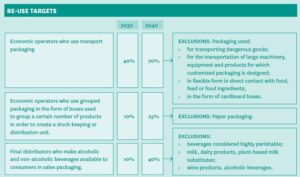
For both Italy and the other Member States of the European Union, the re-use targets are set out in Article 29 of Regulation 2025/40
and have different deadlines.

Re-use targets

Economic operators shall participate in one or more re-use systems and shall report data on the achievement of re-use targets to the competent authority.

  • The report shall be submitted within six months of the end of the reporting year for which the data are collected.
  • The first reporting period shall cover the calendar year starting on 1 January 2030.
  • The competent authorities shall establish electronic systems through which data shall be reported to them and specify the formats to be used.

ADDITIONAL OBLIGATIONS REGARDING REUSE ACCORDING TO REGULATION 2025/40:

  • Final distributors operating in the hospitality sector and using take-away packaging for cold or hot beverages or ready-to-eat food intended for immediate consumption, by filling a take-away container at the point of sale, shall offer consumers the option of reusable packaging within a re-use system by 12 February 2028;
  • From 2030, final distributors shall endeavour to offer 10% of products for sale in a reusable packaging format.

ADDITIONAL REFILL OBLIGATIONS ACCORDING TO REGULATION 2025/40:

  • From 1 January 2030, final distributors with a sales area of more than 400 m² shall endeavour to allocate 10% of that sales area to refill stations for both food and non-food products.
  • Final distributors operating in the hospitality sector and using take-away packaging for cold or hot beverages or ready-to-eat food intended for immediate consumption, by filling a take-away container at the point of sale, shall provide consumers with a system that allows them to bring their own container to be refilled by 12 February 2027.

Regulation 2025/40 does not provide for any incentives for the creation of reusable packaging. The creation and marketing of reusable packaging within a re-use system is a legal obligation.

No, because the re-use requirements set out in Article 29 of Regulation 2025/40 for transport or sales packaging used for transport do not apply, among other things, to packaging in flexible format that is used for transportation and that is in direct contact with food and feed as defined in Article 2 and in Article 3, point (4), of Regulation (EC) 178/2002 or with food ingredients as defined in Article 2, paragraph 22, point (f) in Regulation (EU) 1169/2011 of the European Parliament and of the Council. The references refer to the general definition of “food”, “feed” and “food ingredients” and not to specific types. Food means “any substance or product, whether processed, partially processed or unprocessed, intended to be, or reasonably expected to be ingested by humans”.

Feed means “any substance or product, including additives, whether processed, partially processed or unprocessed, intended to be used for oral feeding to animals”. Ingredient means “any substance or product, including flavourings, food additives and food enzymes, and any constituent of a compound ingredient, used in the manufacture or preparation of a food and still present in the finished product, even if in an altered form; residues shall not be considered as ingredients”.

Article 29, paragraph 6 of Regulation 2025/40 stipulates that from 1 January 2030, final distributors that make alcoholic and non-alcoholic beverages in sales packaging available on the territory of a Member State to consumers shall ensure that at least 10% of those products are made available in reusable packaging within a re-use system. However, the regulation establishes several exemptions from this re-use requirement: for example, paragraph 7 stipulates that the re-use targets shall not apply to beverages considered highly perishable, as well as milk and milk products and plant-based milk substitutes. In addition, paragraph 10 of the regulation stipulates that if, in a given calendar year, a final distributor has a sales area of no more than 100 m², that final distributor shall be exempt from the obligation to meet the targets set out in paragraph 6. There are therefore exemptions related to the type of product or the size of the sales area, but no further exemptions are provided for. Therefore, the general rules of Regulation 2025/40 should also apply to final distributors operating through vending machines. This is without prejudice to the publication by the Commission, by February 12, 2027, of guidelines on the types of beverages that may be subject to the re-use obligations referred to in paragraph 6.

Currently, there are no ongoing considerations by the Commission on the feasibility of these objectives.

On this point, however, paragraph 19 of Article 29 provides that “By 1 January 2034, taking into account the evolution of the state of the art of technology and the practical experience gained by economic operators and Member States, the Commission shall present a report reviewing the implementation of the 2030 targets set out in Article 29. In that report, it shall evaluate, including from the perspective of the life-cycle assessment of single-use and re-use packaging, the following:

  1. the extent to which the 2030 targets have led to solutions fostering sustainable packaging that are effective and easy to implement;
  2. the feasibility of the achievement of the 2040 targets on the basis of the experience in achieving the 2030 targets and the evolving circumstances;
  3. the relevance of maintaining the exemptions and derogations set out in Article 29; and d. the necessity or pertinence of setting new targets for the re-use and refill of other packaging categories."

The exemption provided for in paragraph 14 applies to all the obligations of Article 29 and not only to those of paragraph 6.

The main articles of Regulation 2025/40 concerning “re-use” are:
› Article 11 – Reusable packaging;
› Article 26 – Obligations in relation to reusable packaging;
› Article 27 – Obligation relating to re-use systems;
› Article 29 – Re-use targets;
› Article 30 – Rules on the calculation of the achievement of the re-use targets;
› Article 31 – Reporting to the competent authorities on re-use targets;
› Article 33 – Re-use offer obligation for the take-away sector.

No, in a delegated act adopted on 25 February 2026, the European Commission excluded stretch wrappings and straps used to
secure loads on pallets during transport from the 100% re-use requirement originally set out in Regulation 2025/40 for specific
intra-company and domestic operations.

FAQ PPWR

Scope of application

The amendments made by Regulation 2025/40 to the SUP Directive do not affect the scope of the Directive, which prohibits the marketing of certain single-use plastic products regardless of whether the plastic they are made of is recycled.

The only exemption is that set out in paragraph 3 of Article 5 of Legislative Decree 196 of 8 November 2021 (which transposed the SUP Directive into Italian law), which provides that “The prohibition referred to in paragraph 1 shall not apply to the placing on the market of products made of biodegradable and compostable material, certified as complying with the European standard UNI EN 13432 or UNI EN 14995, with a percentage of renewable raw material equal to or greater than 40% and, from 1 January 2024, greater than at least 60%, in the following cases:

  1. where it is not possible to use reusable alternatives to single-use plastic products intended to come into contact with foods
    listed in Part B of the Annex;
  2. where use is intended in controlled circuits that routinely and consistently deliver waste to the public collection service
    through separate collection, such as canteens, healthcare or social care facilities and residences;
  3. where such alternatives, in view of the specific circumstances of time and place, do not provide adequate guarantees in terms of hygiene and safety;
  4. in view of the particular type of food or drink;
  5. in circumstances where there are large numbers of people present;
  6. where the environmental impact of the reusable product is worse than that of biodegradable and compostable single-use alternatives, based on a life cycle analysis by the manufacturer.”

Yes, as specified in Article 2, Regulation 2025/40 generally applies to:

  • all packaging, regardless of the material used;
  • all packaging waste, regardless of the context in which it is used or from which it originates: industry, other manufacturing, retail or distribution, offices, services or private households.

In any case, the measure does not affect EU provisions on packaging and safety/quality/health protection/hygiene of packaged products, hazardous waste, and transport. However, specific types of packaging may be exempted from the application of certain specific provisions.

Packaging used for the transport of dangerous goods in accordance with Directive 2008/68/EC is not subject to Article 6 on “recyclable packaging”, Article 7 on “minimum recycled content in plastic packaging,” Article 29 on “re-use targets,” and Article 12 on “labelling” with regard to the indication of the material composition of packaging. Furthermore, Article 2 specifies that “where this Regulation conflicts with Directive 2008/68/EC, Directive 2008/68/EC shall prevail”.

The definition of contact-sensitive packaging is given in Article 3, paragraph 1, point (49) of Regulation 2025/40. Contact-sensitive packaging is primary packaging intended for use with products covered by the following regulations, directives and decisions:

European regulations are directly applicable in all EU Member States. In non-EU countries, however, Regulation 2025/40 will not apply, so there may be different provisions in the UK.

Regulation 2025/40 entered into force on 11 February 2025, but its provisions will apply from 12 August 2026, with different obligations and deadlines depending on the measures envisaged.

At present, there are no guidelines on areas of overlap between the two regulations.

In summary, it should be noted that, as the SUP Directive is special legislation, it should take precedence over Regulation 2025/40 with regard to its scope of application.

However, it should be noted that the marketing ban established by Article 25 of Regulation 2025/40 for the specific types of goods listed in Annex V prevails over any national derogations provided for in relation to the ban referred to in Article 5 of the SUP Directive (transposed in Italy by Article 5 of Legislative Decree 196 of 8 November 2021).

An example of a measure in the SUP Directive that prevails over Regulation 2025/40 is the provision in Article 5 on restrictions on placement on the market (transposed in Italy by Article 5 of Legislative Decree 196 of 8 November 2021).

Specifically, the measure provides for a general ban on placing on the market (without prejudice to the derogation referred to in Article 5, paragraph 3, of Legislative Decree 196 of 8 November 2021) for a list of single-use plastic goods, including certain packaging such as, for example, food containers made of expanded polystyrene, i.e. receptacles such as boxes, with or without a cover, used to contain food which:

  1. is intended for immediate consumption, either on-the-spot or take-away;
  2. is typically consumed from the receptacle; and
  3. is ready to be consumed without any further preparation, such as cooking, boiling or heating, including food containers used for fast food or other meal ready for immediate consumption, except beverage containers, plates and packets, and wrappers containing food.

Such packaging, while meeting all the sustainability requirements of Regulation 2025/40, cannot be marketed in any case, as it is subject to a specific ban under the SUP Directive.

Furthermore, the Directive sets out certain additional requirements specific to those established by Regulation 2025/40 for certain categories of packaging.

In this regard, we can mention the marking requirements set out in Article 7, which also apply to beverage cups, and the requirement that caps remain attached to containers, which applies to bottles and composite beverage packaging.

The “deposit and return system” is defined as “a system in which a deposit is charged to the end user when purchasing a packaged or filled product covered by that system, and redeemed when the deposit bearing packaging is returned through one of the collection channels that are authorised for that purpose by the national authorities”. Regulation 2025/40 requires Member States to establish deposit and return systems by 1 January 2029, with particular reference to achieving the target of at least 90% separate collection for:

  1. single-use plastic beverage bottles with a capacity of up to three litres; and
  2. single-use metal beverage containers with a capacity of up to 3 litres.

On a voluntary basis, Member States are encouraged to establish and maintain deposit and return systems for other types of packaging, in particular for single-use glass beverage bottles and beverage cartons.

Annex X to the Regulation 2025/40 sets out the minimum requirements for deposit systems and for the labelling of packaging that is part of a deposit system. This labelling will be defined in an implementing act.

In order to avoid the obligation to establish a deposit system for packaging under points (a) and (b), Member States must achieve a separate collection rate of at least 80% by 2028 and submit a request for a derogation, accompanied by a plan to achieve the 90% target by 2030. If the derogation is granted, it will lapse if the separate collection rate falls below 90% for three consecutive years.

At present, it is not possible to know what national measures will be taken to comply with these requirements.

Contact-sensitive packaging is primary packaging intended for use with products covered by the following regulations, directives and decisions:

Regulation 2025/40 is directly applicable in all EU Member States.

Regulation 2025/40 is directly applicable in all Member States and therefore does not require a national Italian legislative act to be
transposed. Italy will exercise its powers within the limits granted to individual Member States by Regulation 2025/40.

Under Regulation 2025/40, such a trader is considered an “importer”, defined as “any natural or legal person established within the
Union that places packaging from a third country on the market” and is primarily subject to the obligations set out in Article 18 of
Regulation 2025/40.

As specified in Article 2, Regulation 2025/40 applies to all packaging, regardless of the material used, and to all packaging waste,
regardless of the context in which the packaging is used or the origin of the packaging waste. However, specific exemptions are
provided for certain types of packaging for medical devices and medicinal products.
Article 6 of Regulation 2025/40, which stipulates that all packaging must be recyclable, does not apply to:

  • contact-sensitive packaging of medical devices covered by Regulation (EU) 2017/745;
  • contact-sensitive packaging of in vitro diagnostic medical devices covered by Regulation (EU) 2017/746;
  • contact-sensitive packaging for infant formula and follow-on formula, processed cereal-based food and baby food, and food
    for special medical purposes defined in Article 1, paragraph 1, points (a), (b) and (c), of Regulation (EU) 609/2013.

Paragraphs 1 and 2 of Article 7 of Regulation 2025/40, which impose a minimum recycled content in plastic packaging, do not apply to:

  • contact-sensitive plastic packaging of medical devices, devices exclusively destined for research use and investigational
    devices covered by Regulation (EU) 2017/745;
  • contact-sensitive plastic packaging of in vitro diagnostic medical devices covered by Regulation (EU) 2017/746;
  • packaging of supplies, components and immediate packaging components for the manufacturing of medicinal products covered by Directive 2001/83/EC and veterinary medicinal products covered by Regulation (EU) 2019/6, where such packaging is needed to be in line with the quality standards of the medicinal product.

Paragraphs 2 and 3 of Article 15 of Regulation 2025/40 do not apply to custom-made transport packaging for configurable medical devices and medical systems that are to be used in industrial and healthcare environments. These paragraphs refer, in particular, to the obligation to carry out the conformity assessment procedure for packaging (referred to in Article 38) and to draw up and keep the technical documentation referred to in Annex VII. Article 12 of Regulation 2025/40, which lays down requirements for labelling, does not apply to immediate or outer packaging as defined in Regulations (EU) 2017/745, (EU) 2017/746 and (EU) 2019/6 and Directive 2001/83/EC relating respectively to medical devices, in vitro diagnostic medical devices, veterinary medicinal products and medicinal products for human use, if there is no space on the packaging due to other labelling requirements as defined in those Union legislative acts, or if the labelling of the packaging could jeopardise the safe use of medicinal products for human use or of veterinary medicinal products.

This site is registered on wpml.org as a development site. Switch to a production site key to remove this banner.