Normative context
The “One Europe, One Market” roadmap brings together, within the next 2 years’ timeframe, 4 complementary initiatives that will have major implications for EU Secondary Raw Materials (SRM) value chain:
TEHA and CONAI developed the Study “A New European Industrial Policy for the Circular Economy” with the aimof contributing to the current European regulatory momentum on the circular economy, starting from the recognition of the challenging context currently affecting the EU’s Secondary Raw Materials (SRMs) value chains.
The “One Europe, One Market” roadmap brings together, within the next 2 years’ timeframe, 4 complementary initiatives that will have major implications for EU Secondary Raw Materials (SRM) value chain:
The Critical Raw Materials Centre is a new European Union initiative designed to strengthen access to critical raw materials, which are essential for the energy, digital and industrial transitions. The initiative will be responsible for monitoring market developments, promoting investment in strategic value chains, supporting the creation of European stockpiles, and facilitating cooperation between supply and demand. Its objective is to reduce Europe’s dependence on external suppliers and enhance the resilience of supply chains.
The Public Procurement Act is the proposal through which the European Commission intends to reform the regulatory framework governing public procurement. The revision aims to simplify the current rules and integrate criteria related to sustainability, resilience and industrial competitiveness. The legislation seeks to leverage the purchasing power of public authorities to support the green transition, promote sustainable products and materials, and strengthen European value chains in strategic sectors.
The European Products Act is a legislative initiative aimed at updating European rules on products, product compliance and market surveillance. Its objective is to make the system more effective in addressing the challenges posed by e-commerce, digitalisation and the circular economy. The proposal foresees harmonised rules to improve traceability, safety and transparency, thereby contributing to the proper functioning of the European Single Market and facilitating the circulation of compliant and sustainable products.
The Circular Economy Act represents the future European regulatory framework dedicated to the transition towards an increasingly circular economy. The initiative aims to create a Single Market for secondary raw materials by increasing the availability and uptake of recycled materials and promoting greater resource efficiency. Its objectives include reducing dependence on virgin raw materials, harmonising rules across Member States, and strengthening the competitiveness of European industry through circularity.
Building on the evidence gathered, TEHA Group and CONAI have developed a new operating model for the European secondary raw materials market, structured around six pillars, including a cross-cutting pillar dedicated to key enabling factors: energy, data and innovation, skills, and social acceptance.
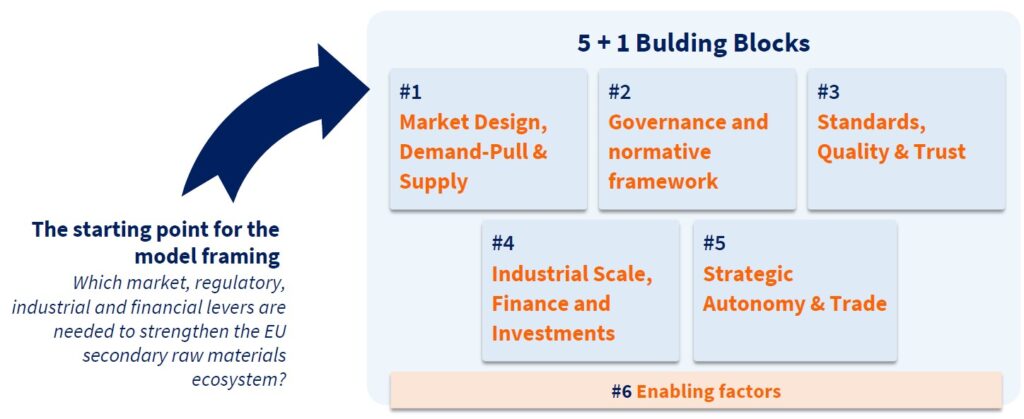
Promote mutual recognition of national specificities, adapting the model to the needs of different value chains and fostering the sharing of best practices
Make recycling investments bankable through stable demand, revised instruments and effective risk-sharing practices (PPP)
Reconnect secondary raw material supply with industrial demand to bridge capacity gaps and keep material loops closed
Reduce dependence on non-EU virgin raw materials and external outlets, while meeting targets and keeping strategic value within Europe
The model translates into 3 policy priorities and a set of underlying actions through which TEHA and CONAI aim to contribute to the debate on the future EU regulatory framework, with the objective of maximising competitiveness, strategic security and value creation through circularity.