Services and tools
Services and tools
Prevention is at the heart of our commitment: in line with Legislative Decree 152/2006, we support companies in reducing the environmental impact of packaging and each year publish a General Prevention Programme to report concrete and measurable actions. We work along two lines:
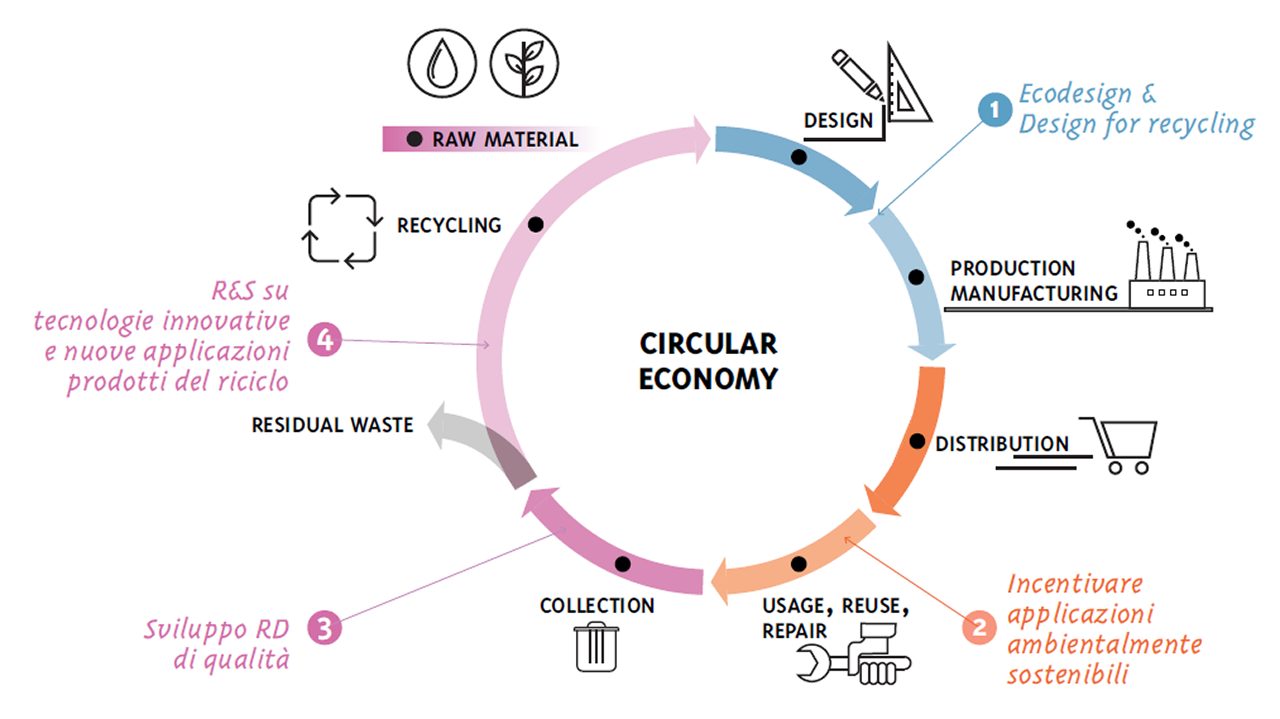
Prevention is the starting point of CONAI’s strategy for the circular economy. It involves every link in the supply chain and includes actors with different roles and interests under a single steering committee, where responsibilities are shared between the public and private sectors.
CONAI is committed to promoting a packaging culture centred on eco-design, helping companies to design sustainable solutions and reduce the environmental impact of packaging throughout its life cycle.
All this is aligned with Legislative Decree 152/06, but above all with our vision for the future – turning regulatory obligations into real opportunities for development.
Designing packaging so that, during its life cycle, it can be moved or rotated a minimum number of times and used for the same purpose for which it was designed.
Designing packaging, purchased by the end user, to be refilled by the distributor or user with the original product.
Simplifying the recovery and recycling phases of packaging (including organic recycling), such as the separability of different components (labels, closures and dispensers, etc.).
Replacing a proportion or all of virgin raw material with recycled/recovered material to contribute to a reduction in resource extraction.
Reducing the consumption of raw materials used in the manufacture of packaging and consequently reducing weight, with the same family of materials, packaged product and performance.
Reducing the mass of virgin raw material used in the manufacture of packaging, with the same family of materials, packaged product and performance.
Implementing innovative manufacturing processes for packaging that can reduce energy consumption per unit produced or reduce production waste or reduce the use of production inputs in general.
Improving warehousing and display operations, optimising pallet and vehicle loads, and perfecting the relationship between primary, secondary and tertiary packaging.
Integrating several functions into a single packaging component, eliminating one element and thereby simplifying the system.
Designing packaging so that, during its life cycle, it can be moved or rotated a minimum number of times and used for the same purpose for which it was designed.
Designing packaging, purchased by the end user, to be refilled by the distributor or user with the original product.
Simplifying the recovery and recycling phases of packaging (including organic recycling), such as the separability of different components (labels, closures and dispensers, etc.).
Replacing a proportion or all of virgin raw material with recycled/recovered material to contribute to a reduction in resource extraction.
Reducing the consumption of raw materials used in the manufacture of packaging and consequently reducing weight, with the same family of materials, packaged product and performance.
Reducing the mass of virgin raw material used in the manufacture of packaging, with the same family of materials, packaged product and performance.
Implementing innovative manufacturing processes for packaging that can reduce energy consumption per unit produced or reduce production waste or reduce the use of production inputs in general.
Improving warehousing and display operations, optimising pallet and vehicle loads, and perfecting the relationship between primary, secondary and tertiary packaging.
Integrating several functions into a single packaging component, eliminating one element and thereby simplifying the system.
The Call for Eco-design Projects was created to promote and reward packaging solutions developed with environmental sustainability and circularity in mind.
The online platform dedicated to the dissemination and public consultation of guidelines for recycling‑oriented packaging design.
The eco-design tool that users can use to calculate the environmental impact of packaging and simulate improvement actions to make it more sustainable.